Education Boards••By Education Board Experts
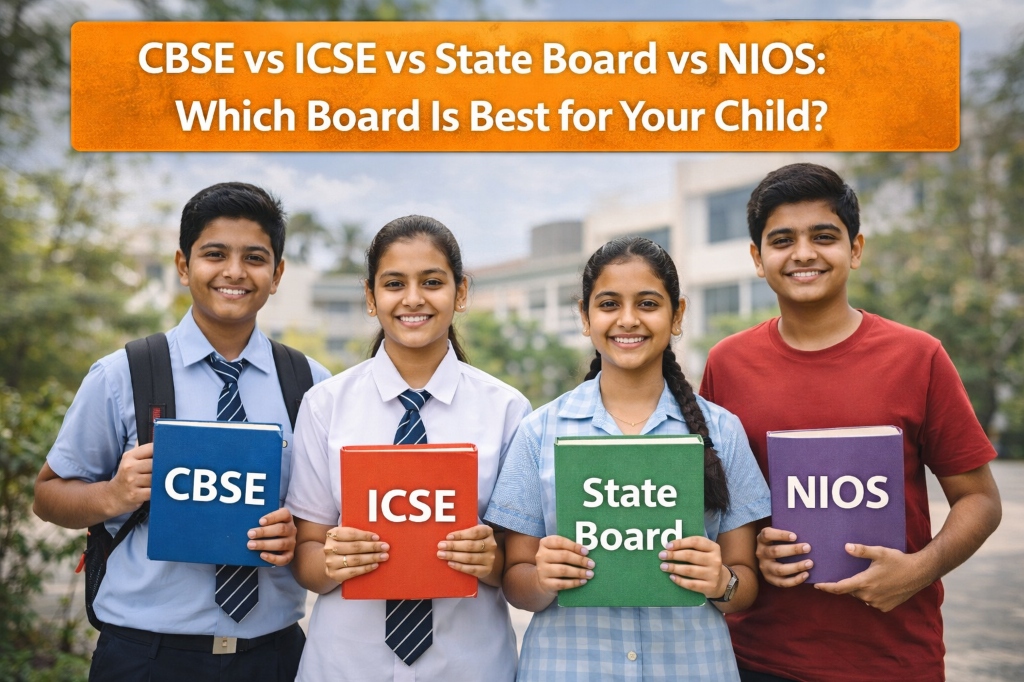
CBSE vs ICSE vs State Board vs NIOS: Which Board Is Best for Your Child?
Choosing the right education board is crucial for your child's future. This detailed comparison of CBSE, ICSE, State Boards, and NIOS helps parents make informed decisions based on their child's learning style and goals.
# CBSE vs ICSE vs State Board vs NIOS: Which Board Is Best for Your Child?
Choosing the right education board is one of the most important decisions parents make for their child. With so many options like CBSE, ICSE, State Boards, and NIOS, it is natural to feel confused. Each board follows a different teaching style, syllabus pattern, and evaluation system, which can impact your child's learning experience and future opportunities.
**The "best" board is not the same for every child.** It depends on learning style, career goals, adaptability, and personal strengths.
Let's understand each board in simple terms.
## CBSE (Central Board of Secondary Education)
CBSE is one of the most popular boards in India. It follows a structured and uniform syllabus across the country. This board focuses on **conceptual learning** rather than memorization. It is especially suitable for students who may prepare for national-level competitive exams like **JEE and NEET**.
### Key Features:
- Nationally recognized and standardized
- Focus on application-based learning
- Regular updates to align with modern education
- NCERT textbooks used across schools
- Wide availability of schools across India
### Advantages:
- Easier for students who relocate frequently
- Strong foundation for competitive exams
- Balanced syllabus—not too heavy
- Recognized by most universities
### Best For:
**Students who want national-level exposure and plan to appear for competitive exams.**
---
## ICSE (Indian Certificate of Secondary Education)
ICSE focuses on **detailed learning and strong language development**. The syllabus is more in-depth compared to CBSE and encourages analytical thinking.
This board emphasizes project work, practical knowledge, and communication skills. **English proficiency** is usually stronger among ICSE students. However, the syllabus can feel heavy for some students.
### Key Features:
- Comprehensive and detailed syllabus
- Strong emphasis on English language
- Balanced approach to arts and sciences
- Encourages analytical and creative thinking
- Project-based learning
### Advantages:
- Excellent English communication skills
- In-depth subject knowledge
- Develops critical thinking
- Well-suited for humanities and creative fields
### Disadvantages:
- Can be academically demanding
- Fewer schools compared to CBSE
- May require more study hours
### Best For:
**Students who enjoy deep learning, reading, writing, and creative thinking.**
---
## State Boards
Each Indian state has its own education board. These boards follow **regional curriculum patterns** and often include local language learning.
State boards are generally more flexible and less academically intense compared to CBSE and ICSE. They are often more affordable and accessible. The level of syllabus quality varies from state to state.
### Key Features:
- Localized content relevant to the state
- Regional language as medium of instruction
- Usually more affordable than CBSE/ICSE
- Flexible and less pressure-oriented
### Advantages:
- Cost-effective education
- Culturally and regionally relevant
- Less academic stress
- Good for students preferring local language
### Disadvantages:
- Limited recognition outside the state
- May not prepare well for national competitive exams
- Quality varies significantly across states
### Best For:
**Students who prefer a relaxed academic pace and regional relevance.**
---
## NIOS (National Institute of Open Schooling)
NIOS is an **open schooling system** that offers flexible learning options. Students can study at their own pace and choose specific subjects.
It is ideal for students who need flexibility—such as **athletes, artists, or students with health concerns**. NIOS certificates are recognized by many universities and institutions.
However, it requires strong self-discipline.
### Key Features:
- Flexible learning schedules
- Option to choose subjects
- No strict attendance requirements
- Self-paced learning
- Recognized by UGC and other bodies
### Advantages:
- Perfect for non-traditional learners
- Allows students to pursue other passions simultaneously
- Can appear for exams multiple times
- Study from home
### Disadvantages:
- Requires high self-motivation
- Limited peer interaction
- Less structured environment
- May not be accepted by some competitive exams/colleges
### Best For:
**Independent learners who need flexibility due to sports, arts, or personal circumstances.**
---
## How to Choose the Right Board for Your Child
Instead of following trends, parents should focus on their child's personality and needs.
### Ask Yourself:
- Does my child enjoy structured learning or flexible schedules?
- Can they handle academic pressure?
- Are they more creative or analytical?
- Do they plan to attempt competitive exams?
- Do they need flexibility for other pursuits (sports, arts)?
- Are they comfortable with self-study or need classroom support?
**There is no "perfect" board—only the right one for your child.**
---
## Common Mistakes Parents Make
Many parents choose boards based on:
- Society's opinion
- Relatives' suggestions
- Brand value of schools
- What worked for someone else's child
**This often leads to stress for the child.**
Education should not be a competition. It should be a foundation for confidence and curiosity.
---
## Quick Comparison Table
| Feature | CBSE | ICSE | State Board | NIOS |
|---------|------|------|-------------|------|
| **Difficulty Level** | Moderate | High | Moderate to Low | Flexible |
| **Language Focus** | Hindi/English | Strong English | Regional | Choice-based |
| **Competitive Exam Prep** | Excellent | Good | Limited | Moderate |
| **Flexibility** | Low | Low | Moderate | Very High |
| **Recognition** | National | National | Regional | National |
| **Cost** | Moderate | High | Low | Low |
---
## Get Professional Guidance
If you still feel confused, professional counseling can help. Platforms like **thevschool.in** assist parents in comparing schools, boards, facilities, and academic approaches so you can make an informed choice.
---
## Conclusion
The best education board is the one that supports your child's growth, not just their marks. Choose wisely, patiently, and thoughtfully.
**Your child's happiness matters as much as their success.**
Remember:
- **CBSE** for competitive exams and national mobility
- **ICSE** for deep learning and strong language skills
- **State Board** for regional relevance and affordability
- **NIOS** for flexibility and personalized learning
The right board today creates the foundation for confident learning tomorrow.
Choosing the right education board is one of the most important decisions parents make for their child. With so many options like CBSE, ICSE, State Boards, and NIOS, it is natural to feel confused. Each board follows a different teaching style, syllabus pattern, and evaluation system, which can impact your child's learning experience and future opportunities.
**The "best" board is not the same for every child.** It depends on learning style, career goals, adaptability, and personal strengths.
Let's understand each board in simple terms.
## CBSE (Central Board of Secondary Education)
CBSE is one of the most popular boards in India. It follows a structured and uniform syllabus across the country. This board focuses on **conceptual learning** rather than memorization. It is especially suitable for students who may prepare for national-level competitive exams like **JEE and NEET**.
### Key Features:
- Nationally recognized and standardized
- Focus on application-based learning
- Regular updates to align with modern education
- NCERT textbooks used across schools
- Wide availability of schools across India
### Advantages:
- Easier for students who relocate frequently
- Strong foundation for competitive exams
- Balanced syllabus—not too heavy
- Recognized by most universities
### Best For:
**Students who want national-level exposure and plan to appear for competitive exams.**
---
## ICSE (Indian Certificate of Secondary Education)
ICSE focuses on **detailed learning and strong language development**. The syllabus is more in-depth compared to CBSE and encourages analytical thinking.
This board emphasizes project work, practical knowledge, and communication skills. **English proficiency** is usually stronger among ICSE students. However, the syllabus can feel heavy for some students.
### Key Features:
- Comprehensive and detailed syllabus
- Strong emphasis on English language
- Balanced approach to arts and sciences
- Encourages analytical and creative thinking
- Project-based learning
### Advantages:
- Excellent English communication skills
- In-depth subject knowledge
- Develops critical thinking
- Well-suited for humanities and creative fields
### Disadvantages:
- Can be academically demanding
- Fewer schools compared to CBSE
- May require more study hours
### Best For:
**Students who enjoy deep learning, reading, writing, and creative thinking.**
---
## State Boards
Each Indian state has its own education board. These boards follow **regional curriculum patterns** and often include local language learning.
State boards are generally more flexible and less academically intense compared to CBSE and ICSE. They are often more affordable and accessible. The level of syllabus quality varies from state to state.
### Key Features:
- Localized content relevant to the state
- Regional language as medium of instruction
- Usually more affordable than CBSE/ICSE
- Flexible and less pressure-oriented
### Advantages:
- Cost-effective education
- Culturally and regionally relevant
- Less academic stress
- Good for students preferring local language
### Disadvantages:
- Limited recognition outside the state
- May not prepare well for national competitive exams
- Quality varies significantly across states
### Best For:
**Students who prefer a relaxed academic pace and regional relevance.**
---
## NIOS (National Institute of Open Schooling)
NIOS is an **open schooling system** that offers flexible learning options. Students can study at their own pace and choose specific subjects.
It is ideal for students who need flexibility—such as **athletes, artists, or students with health concerns**. NIOS certificates are recognized by many universities and institutions.
However, it requires strong self-discipline.
### Key Features:
- Flexible learning schedules
- Option to choose subjects
- No strict attendance requirements
- Self-paced learning
- Recognized by UGC and other bodies
### Advantages:
- Perfect for non-traditional learners
- Allows students to pursue other passions simultaneously
- Can appear for exams multiple times
- Study from home
### Disadvantages:
- Requires high self-motivation
- Limited peer interaction
- Less structured environment
- May not be accepted by some competitive exams/colleges
### Best For:
**Independent learners who need flexibility due to sports, arts, or personal circumstances.**
---
## How to Choose the Right Board for Your Child
Instead of following trends, parents should focus on their child's personality and needs.
### Ask Yourself:
- Does my child enjoy structured learning or flexible schedules?
- Can they handle academic pressure?
- Are they more creative or analytical?
- Do they plan to attempt competitive exams?
- Do they need flexibility for other pursuits (sports, arts)?
- Are they comfortable with self-study or need classroom support?
**There is no "perfect" board—only the right one for your child.**
---
## Common Mistakes Parents Make
Many parents choose boards based on:
- Society's opinion
- Relatives' suggestions
- Brand value of schools
- What worked for someone else's child
**This often leads to stress for the child.**
Education should not be a competition. It should be a foundation for confidence and curiosity.
---
## Quick Comparison Table
| Feature | CBSE | ICSE | State Board | NIOS |
|---------|------|------|-------------|------|
| **Difficulty Level** | Moderate | High | Moderate to Low | Flexible |
| **Language Focus** | Hindi/English | Strong English | Regional | Choice-based |
| **Competitive Exam Prep** | Excellent | Good | Limited | Moderate |
| **Flexibility** | Low | Low | Moderate | Very High |
| **Recognition** | National | National | Regional | National |
| **Cost** | Moderate | High | Low | Low |
---
## Get Professional Guidance
If you still feel confused, professional counseling can help. Platforms like **thevschool.in** assist parents in comparing schools, boards, facilities, and academic approaches so you can make an informed choice.
---
## Conclusion
The best education board is the one that supports your child's growth, not just their marks. Choose wisely, patiently, and thoughtfully.
**Your child's happiness matters as much as their success.**
Remember:
- **CBSE** for competitive exams and national mobility
- **ICSE** for deep learning and strong language skills
- **State Board** for regional relevance and affordability
- **NIOS** for flexibility and personalized learning
The right board today creates the foundation for confident learning tomorrow.